
The Quiet Ways AI Is Killing Your Discernment: A love letter to our clients, our creative process, and ourselves.
Discernment is dying, and I’m watching it happen in my inbox every day.
I’m preparing to name baby girl number two right now, and it’s not as easy as I remembered, folks.
I want her name to be meaningful, flow well with my oldest daughter’s name, and be easy to pronounce. The initials can’t accidentally spell something she gets teased for. My husband and I need to AGREE. And wow there are a lot of names that remind me of mean girls from middle school!! Yikes.
And tbh, it’s kinda terrifying.
More and more feedback comes back to me sounding a little too polished. Emails feel like they have zero personality or personal connection (and ZERO mistakes). And, a bit unrelated but also very related, the social media content and captions?! Jesus.
Don’t get me wrong. I get it. AI is a helpful tool, and I use it too.
But branding and more importantly feedback about your branding is one space where your unfiltered voice is the whole point.
The “I don’t love this and I can’t tell you why” is where great design lives. The half-formed thought. The gut reaction. The email that starts with “Okay, hear me out...” and somehow gets us exactly where we need to go. That’s the good stuff. And lately, I’ve been wondering what happens when we start sanding all of that off before it ever reaches the creative process.
The problem isn’t AI, exactly...
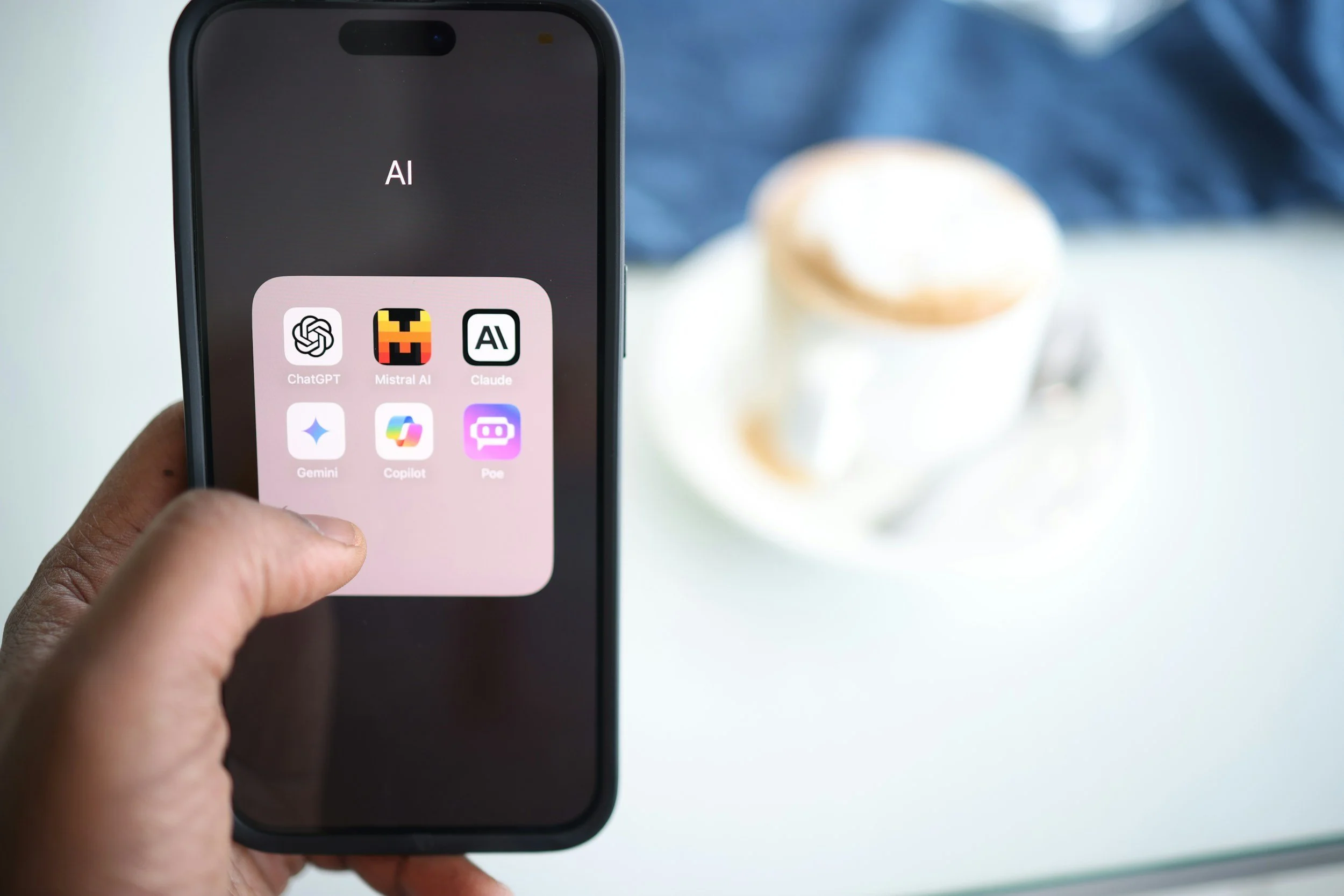
It’s what happens when we reach for Chat or Claude before we’ve used our own noodles.
Let me be clear: I’m not anti-AI. There are a lot of ways AI makes my work faster, easier, and more efficient. I use it and so do our clients. I just don’t want us outsourcing our thinking along with the tasks.
There are some things we need to practice:
Personal taste
Judgment
Feeling like something is just.. off
Knowing what sounds like YOU and what sounds like everyone else
Recognizing that the technically “better” option might actually be the wrong one
That’s discernment. And the more you outsource every tiny decision, the less confident you can become in making the big ones. The ones only you can make for your business.
Here’s where I’m noticing it the most:
1. Filtered feedback
Some feedback is comin’ in a little too... neat.
The meandering gut reactions. The “hmmm, somethings weird with the color” are getting sanded down in a wash of Chat and Claude gooble-de-goop.
“Please adjust the color palette to better align with our established brand identity” tells me a lot less than: “I hate that red. It reminds me of a fast food restaurant.” Give me the fast food comment. I can work with that.
2. Emails has lost its fingerprints
“Smart Compose” and AI summaries sound great in theory. Save a few minutes here. Write a response a little faster there. But I’m getting less and less of the “Happy Fridays” and more: “Sure thing.” “Sure.” “They look great.”
These emails aren’t bad, they’re just... interchangeable.
And yes, I find myself doing this too. But that's what makes me realize how much I miss the more real, raw, emails in my inbox.
Your emails have a fingerprint. Weird sign-offs, overusing exclamation points (I love em!), little inside jokes, the way you say “totally”...
I once had a printer contact attach a different Calvin & Hobbes comic every time I’d request a new quote. Chat and Claude can’t do that or why would they?
Those little things tell me there’s a person on the other side of the screen.
And I don’t want to design a brand for some hypothetical polished version of you. I want to design for the person who actually exists. And as your designer, I really like getting to know you. It helps me create for YOU. The real you. Not the iRobot version.
3. Creative collaboration turns into approval theater
Design isn’t a form to fill out. It’s a back-and-forth.
It’s looking at something together on a shared Zoom screen and saying, “Okay, I actually really like this part, but something about this is bugging me.” Then we poke at it. We try something new, make it worse sometimes, then we arrive at something better. That kind of collaboration can get us to the BEST final edit faster and funner (yes, I said funner) than a tidy summary ever will.
When every creative interaction gets reduced to a questionnaire or a perfectly formatted feedback document, we lose some of the actual collaboration.
4. Your taste stops getting reps in
Discernment is a muscle. Every time you make a small judgment call, you’re getting a rep. Does this feel like us? Do I actually like this? Is this too polished? Is this the right word? Would I say this out loud? Do I want people to see our business this way?
Those little decisions build your confidence in your own taste.
And hey, honey, your taste really matters! Especially to us.
There are plenty of things AI can help you generate. But only you know what feels like your business and what your customers actually like hearing from you.
What we're actually losing when we think we're gaining minutes back
Gut-level feedback.
Kitchen-table language.
Real, relationship-building emails.
Messy, honest collaboration.
Your own taste.
Those things are more valuable than efficiency, IMO. Because when we optimize every interaction for speed, we can accidentally optimize the humanity right out of it.
And that's what actually scares me. We’re becoming a working world of robots out here talking to other robots.
Polished emails to polished emails. AI-generated captions about AI-generated content.
Feedback that’s been cleaned up so thoroughly that nobody can remember what they actually thought in the first place.
And eventually, we risk becoming less practiced at being ourselves.
So what are we doing about it?
Making our work as conversational as possible.
Live workshops instead of questionnaires.
Real email replies instead of “smart” ones.
On-screen editing sessions instead of feedback forms.
And, maybe most importantly, asking our clients to answer in their own words first.
Type it out with cuss words, grammar mistakes, contractions galore. Send the voice memo. The slack message. Write the rambling paragraph. Tell us you don't like something even if you can't explain why.
That’s the version we want to design for. The person behind the professionalism. The person who makes your brand worth knowing in the first place.
So here’s our gentle ask…
(And I’ve also added it to our contract now, so apparently I’m serious about this.)
Before you turn your feedback into a perfectly articulated list of design revisions, tell us what your gut is saying. Before you hit “generate,” ask yourself what you think. You can always polish it later. But give yourself a chance to have the thought first. Give your taste some reps.
And yes, I left some little mistakes in this post too. Because what soapbox would I be standing on if I didn’t let a few slide?